Europe's Forests Are Burning, Breaking, and Beetle-Ridden: The Bill Is Coming Due

For those working in climate, conservation, and natural capital, the trajectory of Europe's forests has been a source of deepening concern for years. A landmark new study published in Science, led by researchers at the Technical University of Munich, has now put hard numbers on that concern.
The headline finding is stark: climate-driven forest disturbances, including wildfires, storms, and bark beetle outbreaks, could dramatically reshape Europe's forests over the coming decades, with the area of damaged forest potentially doubling by 2100 under a worst-case emissions scenario. But the implications run considerably deeper than the headline suggests. When held against the backdrop of other recent research, it becomes a story about economic exposure, carbon feedback loops, regional inequality, and the compounding dynamics of a climate system that is beginning to undermine the very ecosystems we are counting on to help stabilise it.
Three Threats, One Direction of Travel
Published in Science in March 2026, the study was led by researchers at the Technical University of Munich and represents one of the first attempts to quantify how much of Europe's forest could be affected across different climate scenarios. Using multi-decadal satellite observations and advanced forest simulations across roughly 13,000 locations, the team trained an AI-based model on around 135 million data points to project how disturbances may evolve through the 21st century.
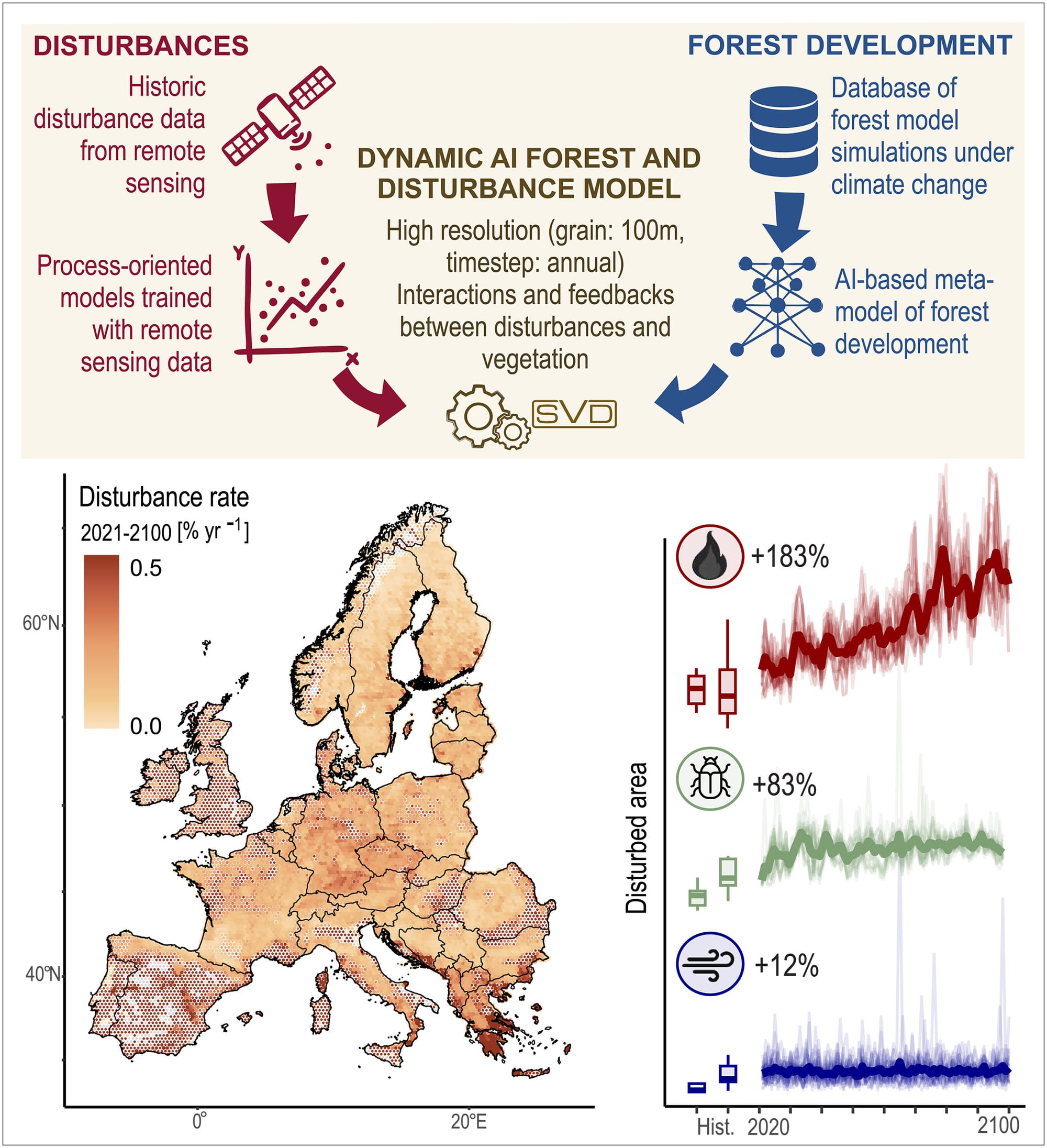
From this, they identified three primary drivers of forest disturbance, each responding to climate change in distinct but reinforcing ways.
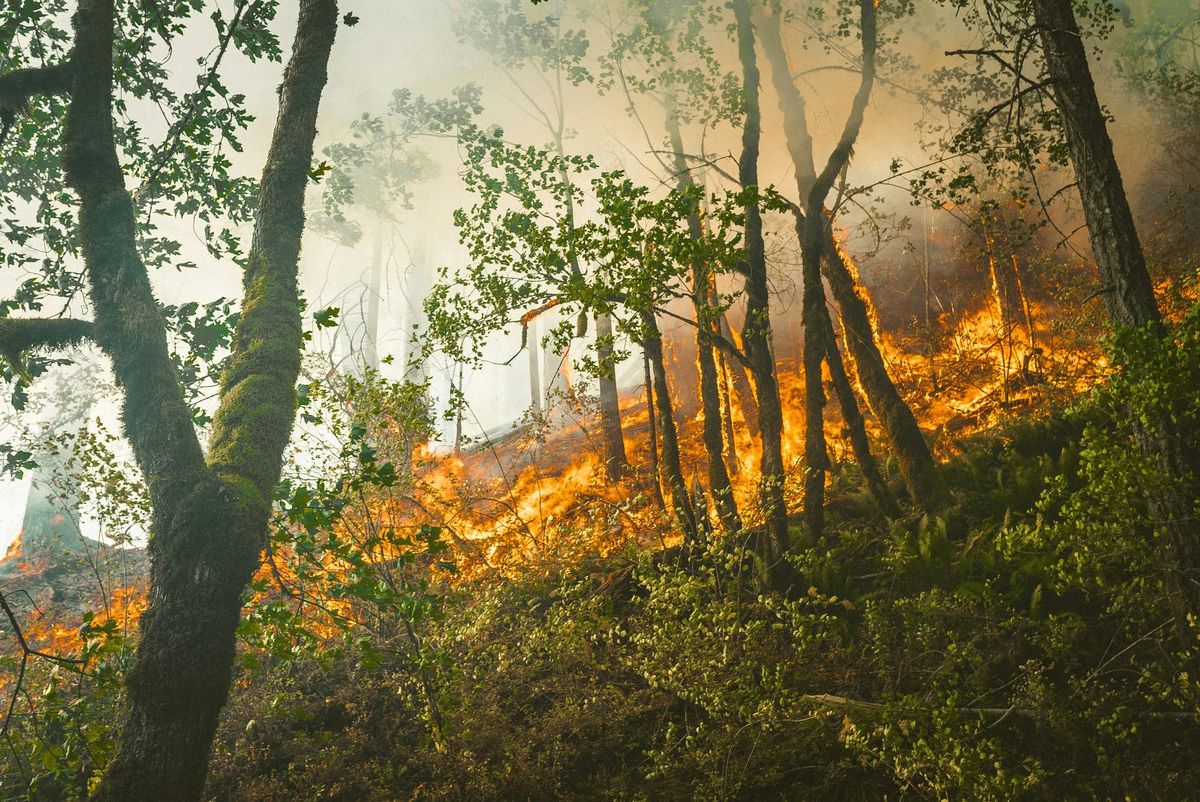
Wildfire is the most climate-sensitive of the three. As temperatures rise and drought conditions intensify across southern Europe, fire risk is increasing in both frequency and severity. The 2025 fire season, which saw the worst blazes across Spain and Portugal in 30 years with over 1% of the Iberian Peninsula burning during a record-breaking heatwave, was not an anomaly to be filed away. Nor was 2024, when wildfire drove record global tree cover loss — the first year in which fire overtook agriculture as the primary driver of tropical forest destruction. These were only previews. The study projects wildfire as the disturbance type most likely to accelerate under future warming scenarios, particularly across the Mediterranean and Iberian regions where the combination of heat, drought, and accumulated fuel loads creates conditions for increasingly uncontrollable fire events.
Bark beetle outbreaks present a different but equally serious challenge. The European spruce bark beetle (Ips typographus) is a native species that plays a natural role in forest ecosystems, but its dynamics are highly temperature-sensitive. Warmer winters reduce the mortality of overwintering beetle populations, while higher summer temperatures accelerate reproductive cycles, in some regions enabling beetles to complete two or even three generations per year rather than one. The result is population explosions that can overwhelm even healthy forest stands, and that are particularly devastating in the managed spruce monocultures that dominate large areas of Central and Northern Europe. Drought-stressed trees, already weakened by water deficit, have reduced capacity to mount resin-based defences against beetle attack, creating a feedback between heat stress and pest vulnerability that the study projects will intensify significantly under continued warming.
Windstorms, while less directly linked to temperature increase than fire or beetles, are projected to remain a significant and potentially intensifying disturbance force, particularly in Northern and Western Europe. Storm-felled trees also create the conditions for subsequent beetle outbreaks, as downed timber provides ideal breeding habitat, illustrating the compounding and interactive nature of these disturbance regimes.
What the study makes clear is that these are not independent risks to be assessed in isolation. They interact, amplify one another, and are all trending in the same direction. In short, the forests of Europe are facing a converging set of pressures that are individually serious, and collectively represent a structural challenge to the continent's forest ecosystems.
The Economic Exposure Is Larger Than Most Appreciate
Six months before the Science article's publication, a companion paper from the same TUM research group, published in Nature Climate Change in September 2025, put hard economic figures on what accelerating disturbance means for Europe's forestry sector.
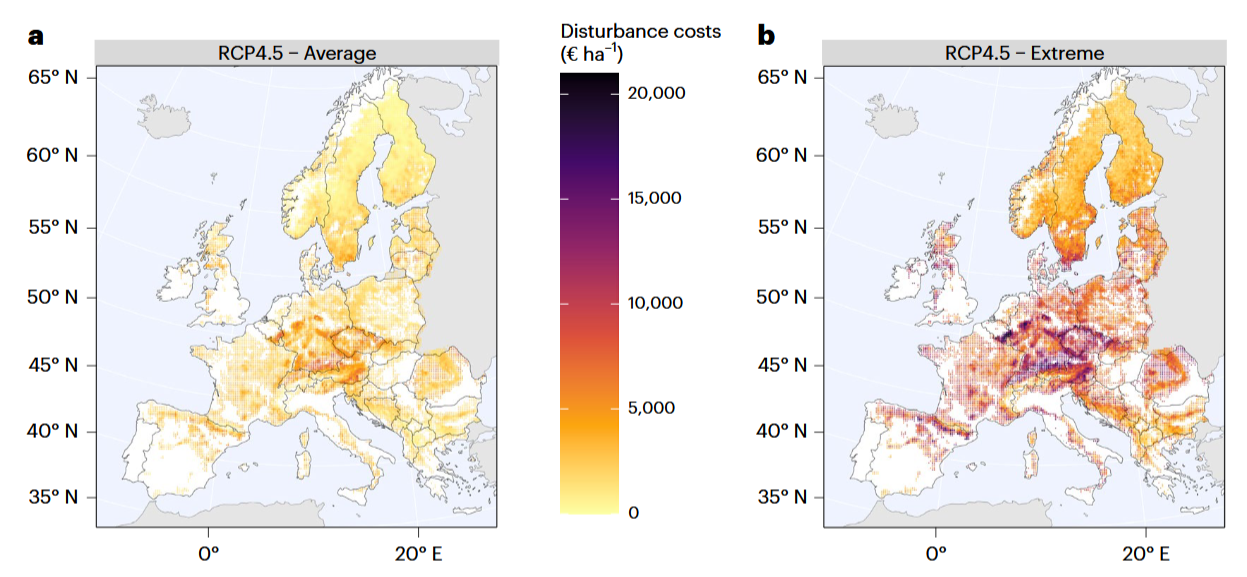
Disturbance-induced losses for Europe's timber-based forestry could increase from the current €115 billion to €247 billion under severe climate change, diminishing the timber value of Europe's forests by up to 42% and reducing the gross value added of the forestry sector by up to 15%. Central Europe emerges as a continental hotspot, with projected future disturbance costs of up to €19,885 per hectare and concentrated in Germany, Austria, Switzerland, and the Czech Republic, where managed spruce forests are most exposed to beetle and storm damage.
The mechanism driving these losses matters as much as the figures themselves. When disturbances strike, timber may suddenly flood the market in large volumes, causing wood prices to collapse. Or, the wood may be so badly damaged it cannot be sold at all. Both dynamics destroy value: the first through price depression, the second through outright asset destruction. For forestry operations with long rotation cycles, a disturbance event can wipe out decades of growth before a single tree reaches harvestable maturity.
There is, however, regional nuance that investors and operators should not overlook. Some regions are poised to experience an increase in forest productivity, attributable to longer growing seasons, elevated CO₂ fertilisation effects, and enhanced nutrient availability under certain climatic scenarios. Climate-related increases in forest productivity could offset future economic losses from disturbances in Northern and Central Europe, but not in Southern Europe where the combination of fire risk and drought stress is projected to outpace any productivity gains. For investors with exposure across the continent, this divergence has direct implications for where climate-adjusted valuations need to be most urgently revised downward.
Taken together, the two TUM studies — one ecological, one economic — make the same argument from different directions: climate risk in European forestry is a present and accelerating financial reality, and the repricing of forest assets across Central and Southern Europe is a question of when, not whether.
A Story of Regional Divergence
One of the more nuanced dimensions of the Science study's findings is the degree of regional variation in projected ecological impacts, which maps closely onto, but does not perfectly mirror, the economic geography described above.
Southern and Western Europe face the most severe projected changes, driven primarily by the wildfire trajectory outlined above. The forests of the Iberian Peninsula, southern France, and the Mediterranean basin are on the front line, and in many cases the ecological communities that currently exist there are not adapted to the fire regimes that are emerging. The result is not merely temporary damage but potential permanent transformation: fire-adapted scrubland replacing closed-canopy forest in areas where the climate envelope has shifted beyond what existing tree species can tolerate.
Northern Europe is projected to be less severely impacted overall, but the Science study cautions against complacency, noting that hotspots of future disturbance are expected to emerge even in lower-risk regions, driven primarily by bark beetle pressure and storm damage. The boreal and hemiboreal forests of Scandinavia and the Baltic states, which represent some of Europe's most significant carbon stores and timber reserves, face their own trajectory of increasing stress.
This regional divergence has practical implications. Conservation strategies designed for a stable climate - including static protected area boundaries, fixed restoration targets, and species management plans based on current distributions - will need to be revisited in light of a disturbance regime that is actively reshaping which areas are ecologically viable, and where intervention is most urgent.
The Carbon Feedback Nobody Wants to Talk About
Perhaps the most consequential dimension of these findings, and the one with the broadest implications for climate policy, is what accelerating forest disturbance means for Europe's carbon balance.
Europe's forests have long been counted as a significant carbon sink, absorbing CO₂ from the atmosphere and partially offsetting emissions from other sectors. However, that sink function is already under pressure. Research published in recent years has documented a declining trend in the carbon absorption capacity of European forests, driven by a combination of disturbance, drought stress, and ageing forest stands. The Science study's projections suggest this trend will only intensify.
When forests are killed by fire, beetles, or wind, the carbon stored in their biomass does not simply stay in the wood. Much of it is returned to the atmosphere, rapidly in the case of wildfire and more slowly through the decomposition of beetle-killed or storm-felled timber. If Europe's forests transition from net carbon sinks to net carbon sources, even temporarily or regionally, the implications for national and EU-level carbon accounting are significant. As the EFI's associated policy brief notes, if forests take up less carbon (or release more than they absorb) it increases pressure on sectors such as transport and agriculture to reduce their emissions more rapidly.
If forest-based carbon sequestration declines or reverses, the remaining carbon budget available to other sectors shrinks. The driving assumption baked into many national climate plans and net zero strategies - that land use and forestry will continue to deliver a reliable carbon sink contribution - deserves urgent scrutiny.
Sadly, this risk is not hypothetical. It is a trajectory already visible in the data, and one that the Science study projects will intensify under continued warming. The question for policymakers and climate strategists is not whether to account for this possibility, but how to plan for it.
What This Means In Practice
For professionals across climate, conservation, and natural capital, the practical implications of these findings are significant.
For conservation practitioners: disturbance ecology needs to move closer to the centre of forest management and restoration planning. The species compositions, structural characteristics, and management regimes appropriate for a stable European climate are not necessarily appropriate for the one that is arriving. Building disturbance resilience through greater structural and species diversity, strategic fuel management, and adaptive planning frameworks is becoming a core conservation competency rather than a specialist niche.
For carbon market participants: the integrity of forest-based carbon credits depends on the permanence of the carbon stored. Accelerating disturbance risk is a direct threat to that permanence, and it is a risk that buyers, verifiers, and standard-setters need to price more rigorously than many currently do. Buffer pools and reversal mechanisms that were calibrated for a different disturbance regime may prove inadequate.
For policymakers: the Kunming-Montreal framework's targets for forest protection and restoration were set against a backdrop of growing forest disturbance risk. Meeting those targets in area terms while the ecological integrity of protected forests is being undermined by fire, beetles, and storms is not the same as meeting them in substance. The policy framework needs to catch up with the ecological reality.
Across all three areas, technology is becoming an indispensable part of the response. Machine learning, remote sensing, and AI-driven monitoring tools are increasingly giving forest managers, investors, and policymakers capabilities that simply didn't exist a decade ago. A great example of this is the early detection of bark beetle infestations, where remote sensing and machine learning can be combined to identify attacks before visible damage appears, across vast and otherwise unmonitorable areas, or using machine learning with sensor networks to detect wildfires before they can spread.
The Science study from the Technical University of Munich is not the first to raise the alarm about Europe's forests, and it will not be the last. But read alongside the Nature Climate Change economic analysis from the same group, the two papers together make a case that is both ecologically and financially hard to dismiss.
The trajectory is clear; the question now is whether the response - in policy, in investment, and in conservation practice - can move at the speed the situation demands.